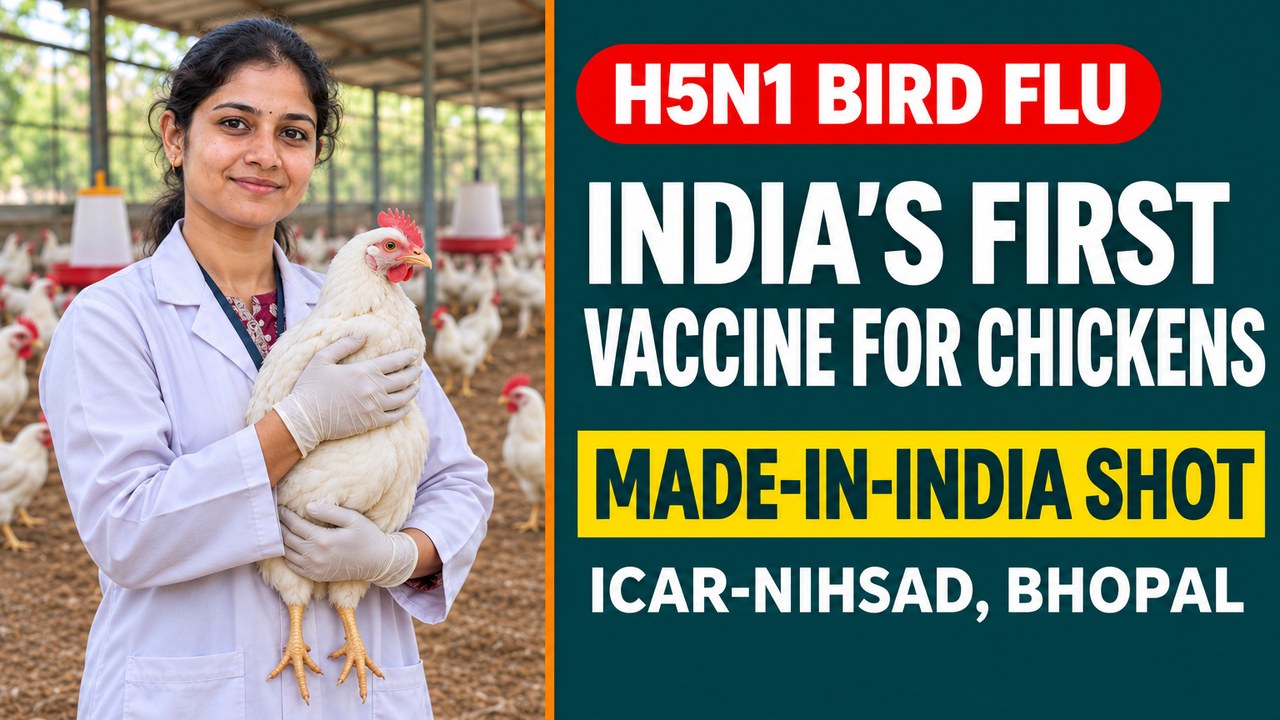
India now has its own H5N1 bird flu vaccine for poultry. On 20 November 2026, Union Agriculture Minister Shivraj Singh Chouhan launched the country’s first indigenous inactivated H5N1 (Clade 2.3.2.1a) vaccine for chickens at the ICAR-National Institute of High Security Animal Diseases (ICAR-NIHSAD) in Bhopal.
The vaccine targets the exact virus strain behind most bird flu outbreaks in Indian chickens, a disease that has repeatedly forced mass culling and heavy losses for poultry farmers. Officials described the launch as a milestone for India’s self-reliance in animal-health science.
H5N1 bird flu vaccine: key facts at a glance
| What | India’s first indigenous inactivated H5N1 vaccine for chickens |
| Launched by | Union Agriculture Minister Shivraj Singh Chouhan |
| Date | 20 November 2026 |
| Where | ICAR-NIHSAD, Bhopal |
| Virus targeted | H5N1, Clade 2.3.2.1a (Highly Pathogenic Avian Influenza) |
| Developed by | ICAR-NIHSAD |
| Also announced | A BSL-4 laboratory at ICAR-NIHSAD (₹300 crore) |
What was launched
The new vaccine is an inactivated (killed-virus) shot that specifically targets the H5N1 virus belonging to Clade 2.3.2.1a, which the government says has been responsible for most bird flu outbreaks in chickens in India. It is a vaccine for chickens, not a human vaccine, and is meant to protect flocks against Highly Pathogenic Avian Influenza (HPAI).
ICAR says the vaccine was developed indigenously at ICAR-NIHSAD, Bhopal, the country’s top high-security animal-disease laboratory. The stated aims are to protect poultry farmers, safeguard livelihoods, reduce economic losses and strengthen India’s preparedness and biosecurity against bird flu.
Why it matters: bird flu in India
Avian influenza has been a recurring threat to India’s poultry sector. According to figures cited at the launch, India has reported more than 500 combined H5N1 and H5N8 outbreaks since 2006, and the 2006 avian influenza outbreak alone caused estimated losses of ₹2,200 to 3,000 crore. For context, foot-and-mouth disease causes annual livestock losses of around ₹22,000 crore.
Each outbreak typically triggers large-scale culling of birds to stop the spread, hitting farmers’ incomes hard. A targeted vaccine offers a way to protect flocks and reduce the need for such culling.
A ‘world first’ against this strain
ICAR’s Director General and Secretary of the Department of Agricultural Research and Education (DARE), Dr M.L. Jat, called the vaccine a “historic achievement in strengthening India’s animal health security and self-reliance in vaccine development,” and said that “no vaccine was available globally against this variant.” The official release likewise states that no specific commercial vaccine was previously available against this particular variant.
What officials said
Minister Shivraj Singh Chouhan described the vaccine as “a historic achievement and a matter of national pride.” Dr Raghavendra Bhatta, Deputy Director General (Animal Science), ICAR, called the launch “a proud testament to the country’s scientific excellence.” The event at Bhopal was attended by ICAR scientists, state representatives and more than 20 ICAR institute directors.
A new BSL-4 laboratory for Bhopal
At the same event, Chouhan announced that a Biosafety Level-4 (BSL-4) laboratory would be set up at ICAR-NIHSAD, Bhopal, at an estimated cost of ₹300 crore. A BSL-4 lab is the highest-containment facility, used for advanced research, early detection, surveillance and control of dangerous emerging animal diseases.
What happens next
The vaccine has been launched by ICAR, but the official release did not announce a retail price or a market-release date; the poultry industry is expected to help take the technology from the laboratory to field use. Some news reports have put the likely cost at around ₹1 to 2 per dose, but that figure was not confirmed in the official announcement and should be treated as unofficial for now.
Important links
| ICAR launch announcement | ICAR press release |
| Indian Council of Agricultural Research | icar.org.in |
| Dept. of Animal Husbandry and Dairying | dahd.gov.in |
| Cabinet / PIB | PIB release (20 November 2026) |
Frequently asked questions
What is India’s new H5N1 bird flu vaccine?
It is India’s first indigenous inactivated H5N1 vaccine for chickens, targeting the Clade 2.3.2.1a strain of Highly Pathogenic Avian Influenza. It was launched on 20 November 2026 at ICAR-NIHSAD, Bhopal.
Is this a vaccine for humans?
No. It is a veterinary vaccine for chickens, meant to protect poultry flocks from bird flu, not a human H5N1 vaccine.
Who developed the vaccine?
It was developed indigenously by the ICAR-National Institute of High Security Animal Diseases (ICAR-NIHSAD) in Bhopal.
Why is it significant?
ICAR says no vaccine was previously available globally against this specific H5N1 variant, so it marks a step forward for India’s animal-health self-reliance and could help reduce the mass culling that follows bird flu outbreaks.
How much will it cost and when will it be available?
The official launch release did not specify a price or a market date. News reports have suggested a cost of around ₹1 to 2 per dose, but that is unofficial and yet to be confirmed.
Based on the ICAR / Press Information Bureau announcement of the launch of India’s first indigenous H5N1 (Clade 2.3.2.1a) vaccine for chickens at ICAR-NIHSAD, Bhopal (20 November 2026). Price, dosage and commercial-availability details were not in the official release and are noted here as unconfirmed. This article will be updated as more official details emerge.