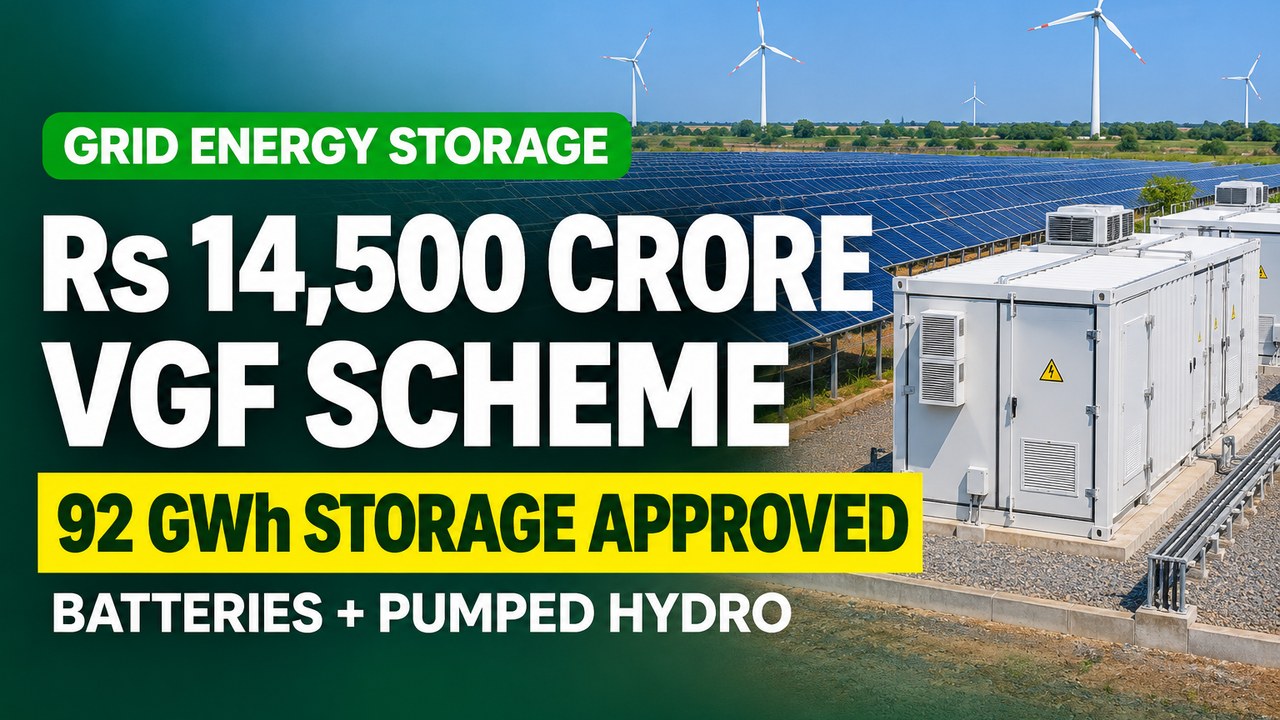
India is about to give its power grid a major storage boost. On 4 November 2026, the Union Cabinet, chaired by Prime Minister Narendra Modi, approved a ₹14,500 crore energy storage scheme, a Viability Gap Funding (VGF) package to develop 92 GWh of grid-scale energy storage capacity between FY 2026-27 and FY 2030-31.
The idea is simple but important: store the electricity India generates from solar and wind so that clean power is available round the clock, not only when the sun is shining or the wind is blowing. The money will back a mix of pumped hydro storage, batteries and emerging storage technologies.
Energy storage scheme 2026: key facts at a glance
| Scheme | Viability Gap Funding (VGF) for Grid-Scale Energy Storage Systems |
| Approved by | Union Cabinet, 4 November 2026 |
| Ministry | Ministry of Power |
| VGF support | ₹14,500 crore |
| Period | FY 2026-27 to FY 2030-31 |
| Storage capacity created | 92 GWh |
| Total estimated investment | ₹97,600 crore |
| Domestic content (BESS) | Minimum 40% |
| Target | 411 GWh grid storage capacity by 2031-32 |
What the Cabinet approved
The Cabinet cleared a Viability Gap Funding Scheme for the Development of Grid-Scale Energy Storage Systems, with total financial support of ₹14,500 crore spread over five years, from FY 2026-27 to FY 2030-31. Viability gap funding is a one-time grant that bridges the gap between a project’s cost and what it can realistically earn, making otherwise unviable infrastructure bankable.
According to the government, the scheme will create new capacity equal to about 170% of India’s present-day grid-scale energy storage, and help the country reach the roughly 411 GWh of grid-scale storage it is projected to need by 2031-32. The total investment expected to flow into these projects is ₹97,600 crore.
What is grid-scale energy storage?
Solar and wind power are clean but variable: generation peaks during the day or in windy spells and drops off otherwise. Grid-scale energy storage soaks up the surplus when generation is high and releases it when demand peaks, for example in the evening. This keeps the grid stable and lets India lean less on coal-based plants to balance supply.
By funding large storage projects, the scheme aims to make renewable electricity dependable enough to supply “round-the-clock” power, a long-standing challenge as India adds more solar and wind to its grid.
The 92 GWh breakdown
The 92 GWh of capacity under the scheme is split across three technologies:
| Hydro Pumped Storage Plants (PSP) | 60 GWh |
| Battery Energy Storage Systems (BESS) | 30 GWh |
| Alternative / emerging storage technologies | 2 GWh |
| Total | 92 GWh |
Pumped storage uses surplus power to pump water uphill to a reservoir, then releases it through turbines to generate electricity when needed. Battery systems store power chemically for fast, flexible discharge. This round is notable for covering pumped hydro and newer technologies, not batteries alone.
A push for ‘Make in India’ batteries
A key aim of the scheme is to build up India’s domestic energy-storage manufacturing and cut reliance on imported components. To that end, battery storage projects under the scheme will have to meet a minimum Domestic Content Requirement (DCR) of 40%.
The government says this will encourage local manufacturing, create opportunities for Indian industry and complement existing supply-side incentives for battery making, in line with the Atmanirbhar Bharat and Viksit Bharat goals.
How the scheme will be rolled out
- Storage capacity will be allocated through a tariff-based competitive bidding process.
- Public and private sector electricity distribution companies (DISCOMs) will be eligible for VGF support for BESS and Hydro PSP projects.
- Projects based on alternative energy storage technologies will be implemented by public and private sector entities.
- The VGF grant is meant to improve the financial viability of these projects and speed up large-scale deployment.
Why it matters
For ordinary consumers, more grid storage means a steadier electricity supply and fewer shortfalls during peak evening demand, even as the share of solar and wind rises. For the wider economy, the scheme is designed to strengthen grid stability, improve renewable energy integration, boost domestic battery manufacturing and enhance India’s energy security, all while helping the country move towards its clean-energy targets.
Important links
| Cabinet decision (PIB) | PIB release, 4 November 2026 |
| Ministry of Power | powermin.gov.in |
| Ministry of New and Renewable Energy | mnre.gov.in |
Frequently asked questions
What is the energy storage scheme approved in November 2026?
It is a ₹14,500 crore Viability Gap Funding scheme approved by the Union Cabinet on 4 November 2026 to develop 92 GWh of grid-scale energy storage in India by FY 2030-31.
How is the 92 GWh of storage divided?
The capacity is split into 60 GWh of pumped hydro storage, 30 GWh of battery energy storage systems (BESS) and 2 GWh of alternative storage technologies.
What is the domestic content requirement?
Battery energy storage projects under the scheme must meet a minimum Domestic Content Requirement of 40%, to promote indigenous manufacturing.
How will projects be selected?
Capacity will be allocated through tariff-based competitive bidding, with public and private distribution companies eligible for the viability gap funding.
How much total investment is expected?
The scheme is expected to attract a total investment of about ₹97,600 crore across the storage projects it supports.
Based on the Press Information Bureau release of the Ministry of Power on the Cabinet’s approval of the Viability Gap Funding Scheme for Grid-Scale Energy Storage Systems (4 November 2026). Figures are as stated by the government and may be updated as the scheme guidelines are issued.